
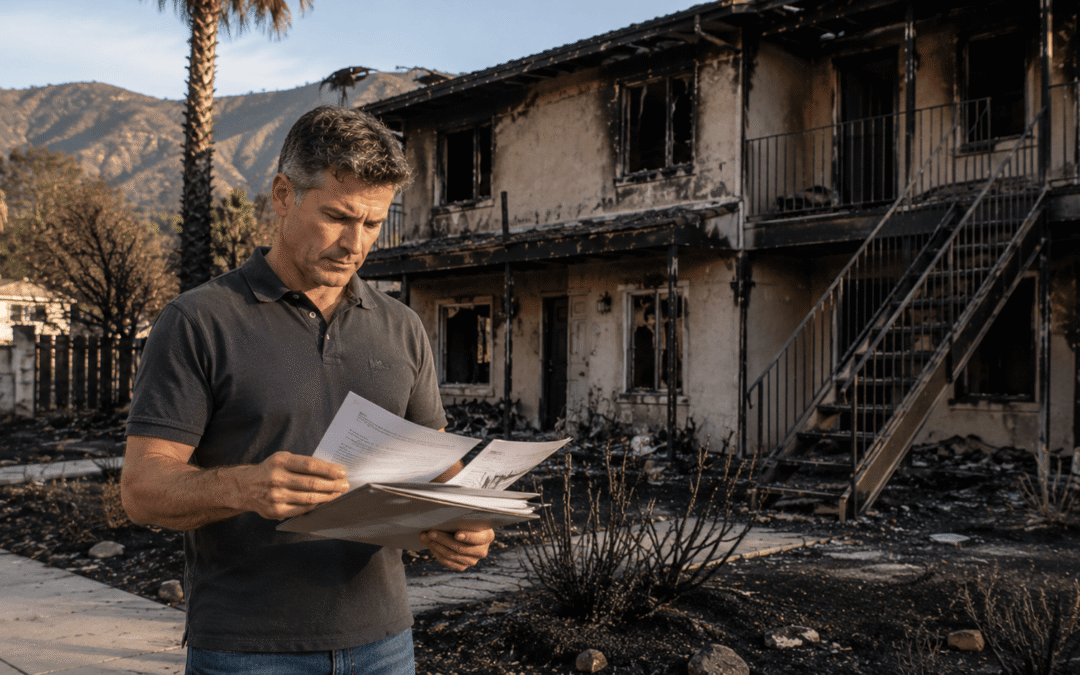
Can Eaton Fire victims recover lost rental income? If you own a rental home, duplex, apartment, accessory dwelling unit, or other income property that was damaged or made unlivable by the Eaton Fire, you may be able to recover lost rent. Insurance policies like Fair Rental Value, Loss of Use, or business income coverage might help, depending on your policy and situation. Compensation isn’t automatic, though. You will need to know your policy limits, show your past rental income, prove how the fire affected your property, and file a strong claim. This guide covers what you need to know about getting back lost rental income after the Eaton Fire.
Table of Contents:
- Can Eaton Fire Victims Recover Lost Rental Income?
- What Is Lost Rental Income After a Wildfire?
- How Fair Rental Value Coverage May Help?
- Who May Be Eligible to Recover Lost Rental Income?
- How Is Lost Rental Income Calculated?
- Documents That Can Help Support a Lost Rental Income Claim
- The Property Does Not Always Need to Be Completely Destroyed
- How Long Can Rental Income Coverage Last?
- Common Problems With Lost Rental Income Claims
- 5 Important Questions About Eaton Fire Lost Rental Income
- What About California FAIR Plan Properties?
- Steps Property Owners Should Take Now
- Why Rental Income Matters During Eaton Fire Recovery?
- Final Thoughts
- Protect the Full Value of Your Eaton Fire Recovery
Can Eaton Fire Victims Recover Lost Rental Income?
In many cases, Eaton Fire victims can recover lost rental income if wildfire damage or related problems made their insured rental property uninhabitable. The amount and length of compensation depend on the details in your insurance policy. Many residential property policies include Fair Rental Value coverage, which can pay property owners for rental income lost while part of the property cannot be lived in.
The California Department of Insurance explains that Fair Rental Value coverage can pay the insured the fair rental value of the portion of a residence rented to others when it becomes uninhabitable because of a covered loss, minus expenses that do not continue. At the same time, the property cannot be occupied.
This difference matters. Insurance generally does not simply reimburse every dollar a landlord says would have been earned. The insurer may evaluate:
- The property’s rental history
- The amount tenants were paying before the fire
- Whether the property was occupied
- Whether there was a valid lease
- The property’s fair market rental value
- The period during which the property was actually uninhabitable
- Expenses that stopped because the unit was vacant
- Policy limits and exclusions
- The length of time reasonably required for repair or rebuilding.
If you relied on rent to pay your mortgage, property taxes, insurance, maintenance, or household bills, getting this income back can be a key part of your financial recovery.
What Is Lost Rental Income After a Wildfire?
Lost rental income is the rent you would have received if a covered disaster had not stopped your tenants from living in the property. Here’s a simple example.
A property was rented for $3,500 per month before the Eaton Fire. The fire makes the home completely uninhabitable for 10 months. The owner could potentially suffer:
$3,500 × 10 months = $35,000 in gross lost rent.
But that does not mean the insurance company will automatically pay $35,000. The policy may require adjustments for expenses that stopped during the uninhabitability period.
For example, if the owner normally paid certain utilities on behalf of the tenant but no longer had to pay them while the property was vacant, those avoided expenses might be deducted when calculating Fair Rental Value benefits.
So, the final amount depends on your financial records and what your insurance policy says.
How Fair Rental Value Coverage May Help?
One key term to look for in your insurance policy is Fair Rental Value, which is sometimes part of a larger Loss of Use section.

California insurance guidance describes Additional Living Expense, Loss of Use, and Fair Rental Value as related forms of coverage addressing the financial consequences of a residence becoming unsafe or uninhabitable because of a covered event such as wildfire. For owner-occupied properties, Loss of Use coverage may help with additional living expenses.
For a portion of a residence rented to another person, Fair Rental Value coverage may instead compensate for rent you cannot collect. In contrast, that portion of the residence is uninhabitable.
For example, coverage may potentially become relevant when an owner rents:
- A single-family rental house
- A duplex
- A triplex or small multifamily property
- A guest house
- An accessory dwelling unit
- A separate unit on an owner-occupied property
- A room or portion of a residence, depending on the policy
Don’t assume every policy is the same. Coverage, limits, endorsements, deductibles, exclusions, and definitions can vary widely.
Who May Be Eligible to Recover Lost Rental Income?
You may have a better chance of claiming lost rental income if certain conditions are met. First, the fire or related damage must generally be a covered cause of loss under the applicable policy.
Second, the property must usually have become uninhabitable or unavailable for rental because of the covered loss.
Third, the owner must show that rental income was actually being received or could reasonably have been expected. A landlord with an existing tenant and written lease, for instance, will generally have straightforward evidence of expected rent.
If your property was recently vacant, your claim may be more complicated. Similarly, if you planned to rent out your property but had not yet found tenants, it may be harder to prove how much income you would have earned.
How Is Lost Rental Income Calculated?
Insurance companies consider several types of evidence when determining Fair Rental Value.
A basic calculation may begin with:
Expected rental income − expenses that did not continue = potential covered rental value
Suppose a landlord previously collected $4,000 every month.
If the property remains uninhabitable for 12 months, the gross potential rental loss would be:
$4,000 × 12 = $48,000
Assume, however, that the owner avoids $250 per month in expenses that would normally have been incurred while the unit was occupied.
That could result in an adjusted calculation of:
$48,000 − $3,000 = $45,000
This is just an example. The actual calculation for your claim will depend on your policy and your property’s details.
Insurance companies may also dispute the appropriate restoration period. An insurer might argue that repairs reasonably should have been completed within a particular period. At the same time, the property owner may contend that rebuilding took longer because of permitting delays, contractor shortages, debris removal, inspections, supply problems, or other circumstances outside the owner’s control. Having good documentation is especially important if there are disagreements.
Documents That Can Help Support a Lost Rental Income Claim
One of the best ways to protect your claim to keep detailed records. Gather as much information as you can to show what your property earned before the Eaton Fire.
Useful records may include:

Keeping these records will help you explain how you calculated your claim.
The Property Does Not Always Need to Be Completely Destroyed
Many people think rental-income coverage only applies if a house is destroyed.
That’s not always the case. A property can remain standing and still be unsafe or uninhabitable because of conditions such as:
- Smoke contamination
- Fire debris
- Toxic ash
- Damaged electrical systems
- Water damage
- Structural problems
- Loss of essential utilities
- Hazardous materials
- Restricted access
Following the 2025 Southern California wildfires, including the Eaton Fire, the California Department of Insurance specifically addressed situations where homes remained physically standing but could still be uninhabitable because of hazardous conditions.
The Department emphasized that physical accessibility alone does not mean a home is safe to occupy and cited concerns about toxic ash, contaminated water, fire debris, and loss of essential utilities. So, your insurance claim should not end just because the building was not destroyed.
How Long Can Rental Income Coverage Last?
How long your coverage lasts is one of the most important parts of a lost rent claim.
Policies commonly place both time limits and dollar limits on Loss of Use or Fair Rental Value benefits.
California’s insurance rules provide important protections after declared emergencies, but the exact rules applicable to an individual landlord can depend on the policy and type of property.
The California Department of Insurance has explained that, following a declared state of emergency, qualifying residential policyholders may receive Loss of Use coverage for specified periods and may have rights to extensions when reconstruction is delayed because of circumstances beyond their control. Policies can nevertheless contain monetary limits that may be exhausted before the maximum time period expires.
You should find out:
- Their maximum Fair Rental Value limit
- Any stated time limit
- Whether the limit is expressed as a percentage of another coverage
- When the insurer considers the restoration period to begin
- When the insurer intends benefits to end
- Whether extensions may apply
Don’t wait until your benefits are almost used up to check these details.
Common Problems With Lost Rental Income Claims
Even with coverage, you may still face disputes.
Insufficient Proof of Rent
The insurer may request evidence showing how much rental income was actually being received. An informal cash arrangement without leases, bank deposits, or accounting records can make the claim more difficult to prove.
Disagreement Over Habitability
If you had an informal cash arrangement without leases, bank deposits, or records, proving your claim may be harder. Disputes over habitability, environmental concerns, government restrictions, utilities, repairs, and contractor recommendations can help establish why occupancy was not reasonably possible.
Disagreement Over the Repair Period
A major dispute can involve how long lost rental income should continue.
Insurers may determine that the property reasonably could have been repaired within a particular timeframe. Owners may face unavoidable delays from permitting, debris removal, rebuilding demand, labor shortages, architectural plans, inspections, or construction materials. Keeping a detailed repair timeline can be very helpful.
Policy Limits
Even when a loss is covered, payments generally cannot exceed applicable insurance limits.
Review your declarations page, endorsements, and the full policy, not just a summary.
Failure to Document Continuing Losses
Lost rent can add up month after month. Property owners should maintain an ongoing record showing:
- Rent that would have become due
- Payments actually received
- Vacancy periods
- Repair progress
- Expenses that continued
- Expenses that stopped
- Communications with displaced tenants
5 Important Questions About Eaton Fire Lost Rental Income
1. Can Eaton Fire Victims Recover Lost Rental Income If Their Rental Property Was Destroyed?
Potentially, yes. If the Eaton Fire destroyed a rental property and the applicable insurance policy includes Fair Rental Value, Loss of Use, or another form of rental-income protection, the owner may be entitled to compensation for qualifying lost rent.
The amount depends on the policy limits, previous rental income, applicable deductions, and the period reasonably required to repair or replace the property. Owners should locate their complete insurance policy and identify language referring to:
- Fair Rental Value
- Loss of Use
- Rental Income
- Business Income
- Additional Coverage
- Period of Restoration
A declarations page alone may not contain all of the relevant terms.
2. Can Eaton Fire Victims Recover Lost Rental Income If the Property Was Damaged but Not Destroyed?
Yes, depending on the circumstances and coverage. Destruction is not always required.
If smoke, fire debris, structural damage, contaminated utilities, toxic materials, or other covered conditions made the rental unsafe to inhabit, rental-income coverage may still apply.
California insurance regulators specifically addressed habitability issues after the Eaton and other Southern California fires. They warned insurers that a structure does not automatically become habitable merely because residents can physically access it. Document why tenants could not safely occupy the property.
3. What If the Tenant Stops Paying Rent After the Eaton Fire?
Whether the lost rent is covered depends largely on why the tenant stopped paying. If the tenant cannot occupy the home because a covered wildfire loss made it uninhabitable, Fair Rental Value coverage may address the resulting rental loss.
If a tenant fails to pay for reasons unrelated to wildfire damage, the insurance policy may not cover the missed payment. Owners should document the connection between the Eaton Fire, the property’s condition, tenant displacement, and the resulting loss of rent.
4. What If My Property Was Vacant When the Eaton Fire Happened?
A vacant rental creates a more complicated claim, but that does not automatically mean recovery is impossible. The key question may be whether the owner can establish that rental income would reasonably have been earned.
Potential evidence could include:
- A recently expired lease
- Evidence of previous tenants
- Rental advertisements
- Applications from prospective tenants
- Signed future leases
- Property management agreements
- Comparable rental rates
- Prior rental history
Policy language on vacancy can also matter. Owners should review vacancy provisions carefully because some policies impose restrictions when a property remains vacant for an extended period.
5. How Can Property Owners Strengthen a Claim for Lost Rental Income?
The best claims usually have strong documentation. Property owners should be prepared to establish three things:
First: the amount of rental income they were earning or reasonably expected to earn.
Second: why the property could not be rented because of Eaton Fire-related damage or hazardous conditions.
Third: how long the rental loss reasonably continued.
Supporting evidence can include leases, bank records, tax returns, tenant correspondence, inspection reports, photos, repair estimates, permits, contractor schedules, environmental reports, property management records, and communications with the insurer. The clearer your documentation shows the fire caused your financial loss, the easier it is to explain and support your claim.
What About California FAIR Plan Properties?
Some Eaton Fire properties were insured through the California FAIR Plan. FAIR Plan coverage is different from standard homeowners insurance, so review it carefully.
The California Department of Insurance describes the FAIR Plan as California’s insurance option for property owners who have difficulty obtaining coverage in the traditional market. Because FAIR Plan policies provide more limited property coverage than many comprehensive homeowners policies, consumers may also carry supplemental coverage.
Significantly, Fair Rental Value claims formed part of the losses reported after the 2025 wildfires.
In a California Department of Insurance order concerning FAIR Plan wildfire losses, the Department reported Eaton Fire claims involving both property damage and Fair Rental Value, with some claims reported specifically as Fair Rental Value-only claims. If you have a FAIR Plan policy, review both your FAIR Plan coverage and any extra or supplemental policy you had during the fire.
Steps Property Owners Should Take Now
If you are asking, “Can Eaton Fire victims recover lost rental income?”, do not focus only on whether coverage exists. Focus on building evidence that supports the amount and duration of your loss.
1. Obtain the Complete Insurance Policy

Request the entire policy, including:
- Declarations
- Coverage forms
- Endorsements
- Riders
- Exclusions
- Amendments
Search for terms such as Fair Rental Value, Loss of Use, and Rental Income.
2. Gather Rental Records
Collect several months or years of records. Old records can show a steady rental pattern and make it easier to prove your losses
3. Document the Property’s Condition
Preserve photos, videos, professional assessments, repair estimates, government notices, and inspection results.
4. Keep a Reconstruction Timeline
Record important dates, including:
- Date of loss
- Date tenants evacuated
- Inspection dates
- Debris removal
- Permit applications
- Permit approvals
- Contractor bids
- Construction start
- Inspections
- Delays
- Completion
- Date the property becomes habitable again.
5. Track Lost Rent Monthly
Create a simple spreadsheet showing:

Continue updating the record until the property can reasonably generate rent again.
6. Keep Insurance Communications in Writing
Save emails, letters, estimates, claim decisions, payment explanations, and requests for information. If an important discussion happens by phone, consider writing notes with the date, person contacted, and issues discussed.
7. Review Every Claim Decision Carefully
A partial payment does not always mean your whole claim is settled.
Compare the insurer’s calculation with:
- Your lease
- Actual previous rental income
- Your restoration timeline
- Continuing expenses
- Policy limits
- Applicable policy language
Ask your insurer to explain anything unclear in their calculations.
Why Rental Income Matters During Eaton Fire Recovery?
Rental properties are not merely structures. For many owners, they represent years of savings and an important income source. Rental revenue may be used to cover:
- Mortgage payments
- Property taxes
- Insurance premiums
- Maintenance
- HOA fees
- Property management
- Family living expenses
- Retirement expenses
- Future repairs
When a wildfire takes away that income for months or longer, the financial impact can last long after the fire is over. That is why Fair Rental Value coverage can be an important part of a property owner’s overall wildfire insurance claim. You should look at both property damage and lost income, not just the cost to fix the building.
Final Thoughts
So, can Eaton Fire victims get back lost rental income? For many qualifying property owners, potentially yes. Insurance coverage such as Fair Rental Value or Loss of Use may compensate owners for rent they cannot collect when a covered Eaton Fire loss leaves rental property uninhabitable.
Recovery, however, depends on the specific policy and circumstances. Property owners should determine:
- What coverage was in effect
- How much rental income was being generated
- Why the property became uninhabitable
- How long the loss reasonably continued
- What expenses stopped during the vacancy
- What policy limits apply
- What documentation supports the claim
The California Department of Insurance has repeatedly emphasized the importance of Loss of Use and Fair Rental Value protections for wildfire survivors. It has specifically addressed habitability concerns arising from the Eaton and other Southern California fires. The most important step is to treat lost rental income as a documented financial loss—not simply an estimate.
Protect the Full Value of Your Eaton Fire Recovery
If the Eaton Fire damaged your rental property, your loss may go far beyond fixing walls, roofs, or belongings. Missing months of rental income can be a big financial burden, so don’t overlook it when planning your recovery.

At Eaton Fire, we are committed to helping property owners better understand the issues that can arise after a devastating wildfire and the financial losses that may affect their recovery.
Don’t leave possible rental-income losses undocumented or ignored. Check your policy, keep your rental records, calculate your losses carefully, and find out what compensation you might be able to get. Contact Eaton Fire today for a free consultation.