
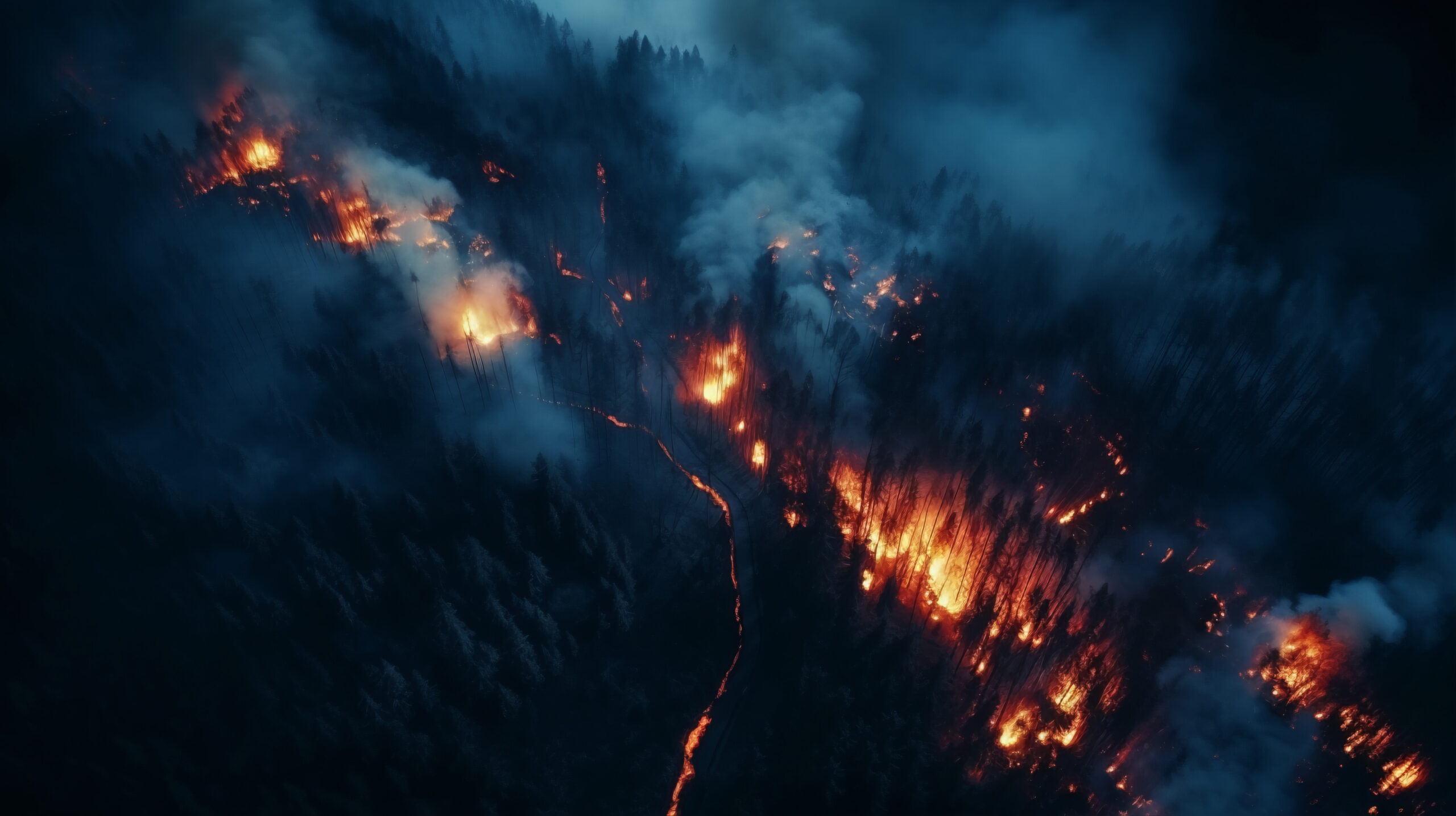
In little time, a wildfire may change a familiar environment into an emergency. For houses near wooded slopes, families visiting a national forest, and communities bordering wilderness, knowledge of how fire moves can assist in explaining why it matters to evacuate early.
Table of Contents:
- How Quickly Can a Forest Fire Spread?
- What Makes a Forest Fire Burn Faster?
- Do All Forest Fires Travel at the Same Speed?
- How Do Embers Carry Wildfires Past the Main Flames?
- How to Prepare for a Rapidly Spreading Fire?
- Frequently Asked Questions
- Eaton: Obtain Fire Help After a Wildfire
How rapidly do wildfires move? There’s no one speed for a forest fire. Some fires crawl over ground fuels; others race through vegetation and tree crowns. Natural Resources Canada says crown-fire spread rates can be as high as 6 kilometers per hour, or around 3.7 miles per hour. That’s an example of forest-fire behavior, not a universal maximum or a prognosis for a specific incidence.
Wind, fuel moisture, terrain, and airborne embers can vary the threat substantially. Understanding the factors that influence these elements is more beneficial than relying on a single speed estimate when your family’s safety is at risk.
1. How Quickly Can a Forest Fire Spread?
A fire can travel slowly through damp or protected fuels or spread rapidly for several miles per hour under conditions that favor rapid spread. Its speed can alter within the same episode.
Firefighters refer to the forward movement as the fire’s rate of spread. The leading edge of the fire spreads through the fuel at a rate described in a forward spread report. It doesn’t necessarily describe all of the perimeter.
A useful contrast is distance vs. area. Miles per hour is a measure of distance traveled. Burned area expansion is measured in acres per hour. Not all parts of a fire move at the same rate. A fire traveling over a wide front might add several acres.
For scale, consider these simplified calculations:
| Assumed constant forward speed | Distance covered in 10 minutes | Distance covered in 30 minutes |
|---|---|---|
| 1 mile per hour | About 880 feet | Half a mile |
| 3 miles per hour | Half a mile | 1.5 miles |
| 6 miles per hour | 1 mile | 3 miles |
These are mathematics samples, not typical forest fire speeds, forecasts, or evacuation countdowns. They presume constant speed in one direction. Real fires can change direction, encounter different fuels, or start new fires ahead of the main front.
For example, using a fire’s reported distance from your home and dividing it by the fire’s latest recorded speed will not provide you a valid evacuation deadline. That assessment doesn’t take into account shifting conditions and the potential of neighboring spot fires.
Fire danger ratings are also a way to give context, not a specific time of arrival. The National Park Service says that with exceptional fire danger, fires can spread quickly and behave erratically. Make judgments based on official incident information and evacuation orders.
2. What Makes a Forest Fire Burn Faster?
Wildfire spread is determined by weather, available fuel, and geography. Any change to any of these changes the way the fire behaves.
Wind and shifting weather
The wind can drive flames into unburned foliage, sending heat closer to the next accessible fuel. Shifts in wind direction might also alter the threatened locations.
Temperature, humidity, and precipitation are important, as they affect fuel moisture. These weather variables, along with fuel and geography, are identified by the National Weather Service as key drivers of wildfire movement.
Therefore, we cannot assume that while we see the fire moving slowly at one time, it will do so at a later time. A household’s plan should include the possibility that conditions may change before everyone is finished packing or has reached a vehicle.
Fuel size and dry vegetation
Fuel is the vegetation that can fire, such as grass, pine needles, leaves, branches, and shrubs.
Fine fuels get hot and burn quicker than big chunks of wood, says Oregon State University Extension. The bigger logs will stay wet inside, but the grass and needles can dry. Even if the landscape has been rained on lately, there may still be fine fuels that will carry fire.
The way fuel is arranged is also important. Shrubs and smaller trees may link the forest canopy to surface vegetation. These connections are known as ladder fuels because they allow fire to climb up into tree crowns.
Slopes and Topography
Slope alters the relationship between the flames and the vegetation in front of them. Fire uphill can push flames into unburned fuel, raising its temperature and igniting it.
The problem in practice is the confluence of conditions. But this is not a sheltering, lush forest floor; this is a wooded slope with dry surface plants and wind blowing toward the hillside.
For residents, checking on every encounter is not a practical substitute for guidance in an emergency. Instead, learn why the behavior of a fire in another place would not do much to comfort you about the circumstances in your community.
3. Do All Forest Fires Travel at the Same Speed?
No. Ground fires, surface fires, and crown flames burn separate layers of fuel, and one wildfire can entail more than one type.
Fires on the ground

Ground fires burn organic matter under surface litter, such as peat or roots. Their movement can be difficult to detect, as the burning may be underground.
So a fire that looks quiet on the surface may still need attention from firefighters. The visible flame is only part of the picture of burning.
Surface fires
Surface fires burn up leaves, dead branches, grass, and other low-level vegetation. They can form little flames or bigger flames that quickly use up available foliage.
A surface fire is a fire that burns on the surface. That doesn’t mean the fire is immediately safe to approach or manageable.
Fires of the Crown
Crown fires burn the crowns of trees or plants. Active crown fires are characterized by a combination of surface and canopy spread. Individual trees may torch, but there is no persistent propagation across adjacent crowns.
A surface fire can turn into a crown fire with the help of ladder fuels, says the National Park Service. One fire can burn the ground, the surface, and the crowns. These distinctions can assist in clarifying why there is no reliable answer just based on the word “forest.” A forest can be made up of grassy clearings, thick bushes, fallen branches, and interlocked tree tops.
So when you’re asking how fast can a forest fire move, think about what fuels are burning and how circumstances are changing. Two flames burning identical land can have different hazards to neighboring towns.
It also helps to separate speed and damage. Fire speed is one aspect of fire behavior, but it does not tell the whole story of how much heat a fire produces or how long material continues to burn. Even a slow-moving fire can cause terrible losses.
4. How Do Embers Carry Wildfires Past the Main Flames?
Burning embers can be blown in front of the fire and start other fires. This process, known as spotting, means danger might arise outside the visible flame front. **
The National Institute of Standards and Technology says embers can move miles in front of a wildfire. They can ignite plants, buildings, decks, sheds, and other flammable elements. Embers can be produced by vegetation and burning structures.
This alters the resident’s perception of distance. Even if a home is not directly next to the present flames, it can still be at risk of catching fire.
Imagine a hypothetical neighborhood isolated from burning vegetation by a street. The road cuts off the continuity of surface fuel, but aerial embers may be carried to flammable material on the other side. So a barrier to flames is not always a barrier to ember exposure.
The same problem affects the notion of a fire “arriving.” A spot fire might start near a property before the main fire front reaches it. Multiple independent ignitions may pose dangers at a number of sites.
NIST also says that embers can ignite hours after the main flame front has passed. Just because a fire has run through an area doesn’t mean a property is safe.”
The practical lesson for households is to obey evacuation and reentry instructions, rather than judge safety by visual flames. Don’t return just because a camera shows less smoke or a hillside far away isn’t burning.
That’s also why wildfire preparedness has to take into account not just the building itself but the vegetation around it. Reducing exposure to embers means paying attention to how a property could catch fire and where the main fire could migrate to.
5. How to Prepare for a Rapidly Spreading Fire?
Prepare before an incident, watch for official alerts, and depart immediately when directed. Don’t make your evacuation strategy based on a guess of how fast the fire is moving.

Head off departure problems
CAL FIRE suggests developing a wildfire action plan, signing up for the alert list, assembling an emergency supplies box, and making plans to take your pets with you. Its evacuation guidance stresses being prepared to depart, and evacuating early.
Design your household’s plan to be specific enough to employ under pressure:
- Work out who will support youngsters, elderly relatives, or anyone else who needs help.
- Keep important medication, paperwork, chargers, and necessary materials accessible.
- Make transportation arrangements for all household members.
- Have pet carriers and leashes handy.
- If family members are separated, agree on a meeting point.
Discuss these agreements before smoke alarms make conversation difficult. If your strategy is based on one person always being home, you might want to have a backup plan.
Understanding directives and warnings
An evacuation warning in California indicates there is a hazard to life or property. It is time to pack to depart. If you need some extra time, consider the warning as a hint to depart a little early.
An evacuation order signifies that there is an immediate threat and you should evacuate immediately. Follow the directions of emergency workers and follow the routes they have designated. Do not return unless officially cleared to do so.
Do not delay departure to finish photographs, acquire additional belongings, or calculate how long the fire could take to reach you.
Mitigate property risks before a fire becomes a threat.
CAL FIRE recommends defensible area and home hardening as part of wildfire preparedness. These are measures that address plants on a property and building elements that affect ignition vulnerability.
Arrange upkeep and enhancements far before an emergency. Property preparedness should complement an evacuation plan; it should never be a justification to stay behind in an order to depart.
Group recovery information together
Once you are secure, create a folder for insurance correspondence, evacuation fees, temporary housing receipts, and details of damaged possessions.
Make notes for yourself: dates, individuals you talked to, papers you sent, and queries that are yet unresolved. Make duplicates of materials before transmitting them elsewhere.
If officials allow you on the scene and it’s safe to do so, photograph the damage. An attorney can analyze your circumstances and explain what further records may aid in assessing a potential claim. The speed of a wildfire alone does not indicate liability or set what compensation may be awarded.
6. Frequently Asked Questions
1. How fast can a forest fire move in miles per hour?
A forest fire’s speed varies with wind, vegetation, moisture, and terrain. Natural Resources Canada describes crown-fire spread rates reaching approximately 3.7 miles per hour. This figure is not a universal maximum, and it should not be used to estimate how long you can safely wait before evacuating.
2. Does wind make a forest fire spread faster?
Wind can push flames closer to unburned vegetation and carry burning embers ahead of the fire. A change in wind direction can also shift which areas are threatened. Follow official incident updates because earlier observations may no longer reflect current conditions.
3. Can a forest fire cross a road?
Yes. Although a road interrupts surface vegetation, windborne embers can travel across it and ignite combustible material beyond the main flames. A road between your property and the fire does not guarantee protection.
4. Is a surface fire safer than a crown fire?
A surface fire is not automatically safe. The term identifies the layer of vegetation burning, rather than a fixed level of danger. Surface fires can spread rapidly through available fuels and may transition into tree crowns when conditions support it.
5. Should I wait until I see flames before evacuating?
No. Follow official evacuation instructions instead of waiting for visible flames. In California, an evacuation order means leave immediately. People who need extra time should leave early during an evacuation warning. Do not delay departure to gather more belongings or calculate the fire’s arrival time.
7. Eaton: Obtain Fire Help After a Wildfire
Knowing how fast a forest fire can move explains why families can be faced with sudden evacuation and terrible disruption. Recovery can involve damaged property, dislocation, lost income, and challenging considerations about insurance and responsibility.
There should be clear instructions regarding your circumstances and what you can do next. The Eaton Fire’s legal team offers legal aid and recovery tools to anyone affected by the Eaton wildfire.

If the Eaton Fire destroyed your house, impacted your business, or hurt your family, Contact Eaton Fire today for a free consultation. Obtain your issue reviewed, obtain answers on your legal alternatives, and take the next move to pursue the recovery to which you may be entitled.
Your healing is important. Contact Eaton Fire and start moving forward with a team that is ready to fight for you.