
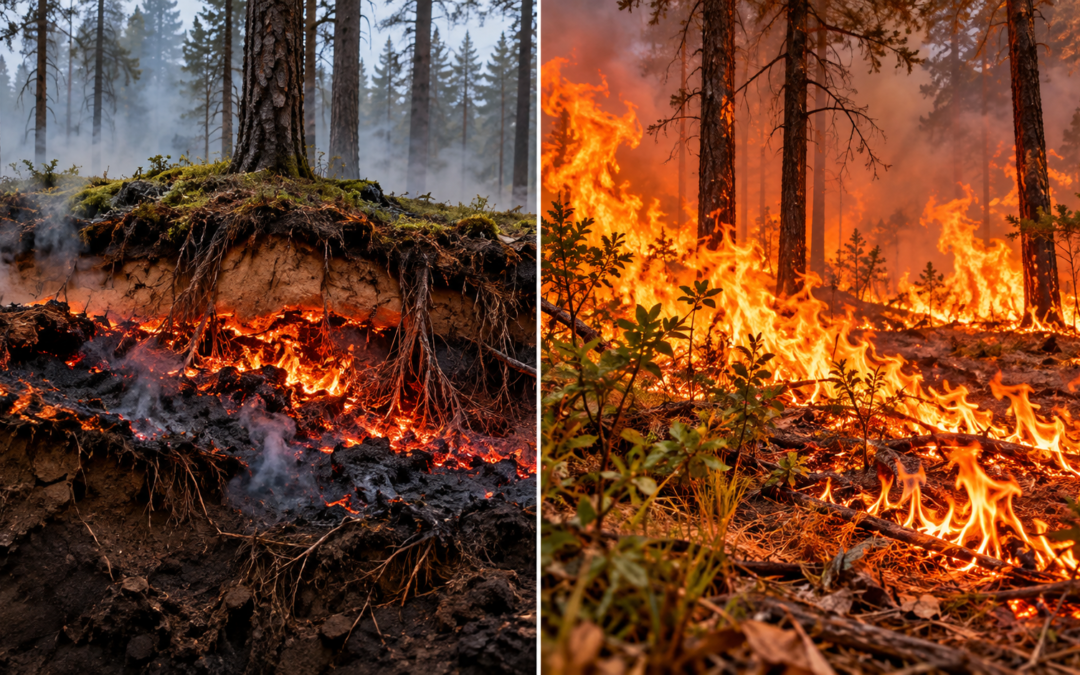
The difference between ground fire vs surface fire changes how a wildfire appears, spreads, and threatens a town. A surface fire consumes the vegetation above the soil, including the leaves, grass, twigs, and other litter. A ground fire consumes the organic material below the surface litter, such as deep muck, peat, or roots. A fire can burn through both layers; therefore, a landscape without apparent flames is not necessarily safe.
Table of Contents
- What is Groundfire?
- What Is A Surface Fire?
- Ground Fire vs Surface Fire: Key Differences
- How Do Surface Fires and Ground Fires Move?
- Homeowner Hazards
- What Homeowners Must Do?
- Ground Fire vs. Surface Fire Frequently Asked Questions
- Call Eaton Fire
Understanding what these terms mean will help residents keep up with updates on incidents and understand why firefighters may be working long after the most obvious flames are out. It also illustrates why the correct answer depends on the circumstances, official guidance, and what fuels are burning near a dwelling.
What is Groundfire?
A ground fire occurs when flammable substances burn beneath the surface of trash. That can include decomposing leaves and needles, deep organic soil layers termed “duff,” peat, roots, and, in some places, coal seams. Fire in such material beneath the surface is termed “ground fire” by the National Park Service (NPS), which adds that this phenomenon is less prevalent than other forms of wildfire.
Fires in the ground commonly smolder rather than burn with a continuous line of visible flame. But smoldering isn’t the kind of combustion most people associate with “wildfire,” with its dazzling flame front. Heat may exist in a fuel bed with simply smoke, warm soil, ash, or no visible indication on the surface. This makes it impossible for the inexperienced eye to tell where burning begins or finishes.
The length of a ground fire is determined by the fuel, the depth and moisture of the fuel, oxygen, weather, and the effectiveness of suppression. Some peat or coal seam fires have been known to burn for very long periods of time, but it doesn’t mean every patch of burning duff will burn for months or years. The practical thing is, underground fuel can hold heat when the neighboring vegetation seems out.
Ground fire is not to be confused with surface fire. In simple words, “on the ground” can mean anything at your feet. In wildfire terms, surface fire means fuel at the surface, while ground fire means fuel below the surface litter.
What Is A Surface Fire?

A surface fire consumes fuels on or just above the forest floor or on open ground such as dried leaves, fallen branches, grass, low plants, and the like. Surface flames may be brief in sparse, moist fuels, but higher and moving quicker in continuous fuels in dry, windy circumstances. NPS says surface fire burns loose surface debris and low vegetation. Surface fire intensity depends on conditions.
Surface fire is often the visible element of a wild fire. It can travel over a hillside or through grass, heating surrounding plants and igniting larger fuels. It can also create embers, which are blown ahead of the flame front. The duration of the flame alone doesn’t tell you if the scenario is safe: wind shifts, a change of fuel, or steep terrain can suddenly modify fire behavior.
A surface fire is not the same as a ground fire, yet both can occur in the same event. An organic layer beneath a surface fire can be ignited and heated. Surface burning, however, may be effective in igniting grass or leaf litter and creating fresh surface fires. So, firefighters are thinking about things bigger than the most obvious fires.
Ground Fire vs Surface Fire: Key Differences

These are normal patterns, not hard and fast rules. A surface fire can burn slowly while a ground fire can reach the surface and produce flames. Neither category predicts a fire’s intensity, speed, or impact on a property. Weather, terrain, the kind and amount of fuel, and structures nearby all are important.
The difference also includes crown fires which are the tops of trees or bushes. Small trees and low branches, known as ladder fuels, can carry surface fires into the canopy. According to the NPS wildfire spread guidance, ground, surface, and crown fire can develop within the same incident. Fire activity is not three separate compartments but an integrated process.
How Do Surface Fires and Ground Fires Move?
A wildfire requires heat, fuel, and oxygen. The direction of fire depends on where the fuel is located. A surface fire travels through a network of grass, debris, brush, and down timber. Wind can push flames into unburned fuel, carry embers beyond the immediate perimeter, and dry out plants. On a slope flames can heat the fuel above it. The direction and intensity of burning can change if the wind changes or if there is a pocket of richer fuel.
Ground fire follows a different path, the heat moving through the layers of fuel below the visible surface. Fire can start anywhere there is fuel and oxygen to sustain it. This would create a fresh source of smoke or light vegetation on fire above. Where deep duff or peat is present, surface water may not penetrate all hot layers. Ground fires are difficult to fight, NPS says, partly because firefighters may need to expose burning material, use water or other necessary agents, and check that heat is gone.
Moisture is necessary, but recent rain does not mean buried heat has been extinguished. The top layer can get wet, and the material underneath stays hot. Similarly, a calm morning does not guarantee consistent conditions later in the day. Homeowners should consult fire officials for current circumstances, containment information, access limits, and evacuation recommendations.
There is a second link that is worth understanding. A fast-moving surface fire may leave flaming logs, roots, or duff behind the main front. Then a smoldering ground fire might keep smoke or heat in an area that looks burned out. That’s why staff may continue inspecting and cooling hot spots during mop-up. That’s the work done after the main spread has been stopped.
Homeowner Hazards
A visible front of flame can travel fast.
Flames or embers can touch combustible items and threaten fences, decks, gardens, sheds, and homes. Vegetation and trash near a structure might offer a pathway for fire. Windblown embers can land around a property and spark spot fires, long before the main flame front arrives. Thus, managing vegetation and eliminating spots where embers can ignite material are a part of home preparation.
The house defensibility recommendation from the U.S. Forest Service promotes removing combustible vegetation and trash from surrounding a residence. The appropriate treatment depends on the local regulations, the topography, the vegetation, and the building. A defensible space lessens risk but doesn’t guarantee survival of all fires.
Hidden heat concerns after flames are out
Ground fire can continue to smolder in stuff that people can’t immediately see. Ash and soil can cover burning material. If conditions allow, surface fuel can re-ignite in a smoldering region. Burned sites can often contain down or weakened trees, damaged utilities, and other postfire hazards. Don’t stroll into a burned zone or try to investigate a smoking patch yourself. If you observe smoke rising from the ground or think there is a hot spot, get away and report it to local fire officials.
The authorities in charge of the incident decide who can enter an impacted neighborhood. What looks like a peaceful property from a distance may be hazardous and there may be an evacuation notice or road restriction in place until lifted by authority.If you are permitted entry, follow local guidance regarding ash, structural damage, utilities and cleanup.
Both types can produce hazardous smoke.
Smoke is more than a visibility problem. Wildfire smoke contains microscopic particulate matter, or PM2.5, which can impair health. The U.S. Environmental Protection Agency (EPA) cites small particles as a severe health threat, especially for children, older adults, pregnant women, individuals with heart or lung problems, and those with high exposure.
The burning of duff may be a continuing local source of smoke. USDA Forest Service research on smoldering duff finds that lower heat can maintain smoke closer to the ground and that smoldering can yield significant fine-particle emissions. Smoke behavior is dependent on the weather and the topography, and the presence of flames does not necessarily indicate the air quality.
Review local air quality information and health alerts. If smoke is affecting your area, the EPA’s indoor exposure guidance recommends closing windows and doors when possible and utilizing appropriate filtration or a portable air cleaner. When inside, heat makes it dangerous; find a cooler, cleaner-air area.
What Homeowners Must Do?

Prior to fire season: Rake leaves and needles from roofs, gutters, and places where embers could collect. Look for safe ways or get help from a person who knows what they are doing. Maintain vegetation and remove combustible litter in and around the home according to local defensible space advice. Plan an evacuation route. If possible, plan more than one route. Keep important papers and prescriptions in an easy-to-get-to place. Learn where your local fire department posts their alerts.
If a wildfire is nearby: Listen immediately to official warnings and evacuation orders. Conditions can change faster than a resident can determine if it is predominantly a ground or surface fire. Do not wait to picture flames, defend a structure without training, or wait until the fire is visible from your home to leave. If there is smoke and you are told to stay inside, follow public health recommendations to decrease exposure and maintain a safe temperature in the space.
Following an evacuation: “Don’t come back until the authorities in this town tell you to. Observe warning signs and instructions on damaged buildings and utilities. Do not smoke on the ground or from ash dumps or near susceptible trees or garbage. Document damage from safe locations safely. “Keep receipts for important expenses. Contact your insurer according to your policy. An authorized specialist may examine structural or environmental dangers as needed.
The steps are the same no matter what label is used in a fire report. “Surface” doesn’t mean benign, and “ground” doesn’t suggest the fire is safely contained under the soil. A household cares about the current threat, directions from local officials, and the state of the house and the land around it.
Frequently Asked Questions
1. How can a surface fire be easily distinguished from a ground fire?
The easiest difference is the location of the burning fuel. A surface fire burns grass, leaves, twigs, and other debris on or near the ground. Ground fire burns deeper organic matter such as duff, peat, or roots. Appearance might offer indications, but it’s not a safe approach for a resident to map an ongoing fire. Even smoke without fire might mean hot peril.
2. Can a ground fire become a surface fire?
Yes. Heat in buried fuel can reach the dry vegetation above it and cause surface flames. It can be the other way around too. A surface fire can ignite organic material lower down. NPS defines these fire categories as capable of interacting within a single incident. This is one reason a smoking location should be reported to the firefighters and left alone.
3. What is more dangerous, surface fire or ground fire?
Neither is invariably riskier. A wind-driven surface fire can spread quickly toward residences and escape routes. Ground fires can be difficult to locate and extinguish and may continue to produce heat and smoke long after the flames are no longer visible. The immediate risk is based on fuel, weather, topography, proximity to people and property, and fire department evaluations.
4. Why might a ground fire continue smoldering after a wildfire is seen to be over?
Deep biological material can retain heat and smolder with minimal visible flame. That substance might ooze out where it hits the air. Crews may need to expose, cool, or remove the burning fuel and recheck the area. Never think that the absence of an open flame indicates the space is safe to enter or that it is proper to extinguish the hot spot yourself.
5. How can the homeowner lessen the risk from the two forms of fire?
Clear combustible debris and vegetation from surrounding your home, maintain your property according to recommendations of your local fire department, and be prepared to evacuate early when told to do so by authorities. Check local notifications and air quality reports. Always wait for formal approval to reenter after a fire. Always get the right help when there is damage or hidden dangers. These steps mitigate risk, but no checklist can eliminate danger.
Call Eaton Fire

Knowing the difference between ground fire vs. surface fire might help you follow a wildfire report, but safeguarding your household demands a plan and quick action. If you’ve been impacted by wildfire or are preparing for future danger,
Contact Eaton Fire today for a free consultation.
Share your story and questions to gain a more profound understanding of your options and move forward with confidence. Call emergency services.If there is an active fire or imminent threat, follow evacuation instructions.